Justin Notarfrancesco
1.0Introduction

NOW ARRIVING

Justin
Notarfrancesco

Frontend Engineer

Wayfinding for the web.

Over five years at JPMorgan Chase. I make pages easy to browse, and fast by loading less.

  • React
  • TypeScript
  • HTML/CSS
  • Performance
Portrait of Justin Notarfrancesco
Fig. 1.1 Justin Notarfrancesco

2.0 At a Glance

I’m Justin, a frontend engineer at JPMorgan Chase. I build the pages people use to find something and decide on it: browsing, filtering, and the detail page that answers their questions. Five years in, I’ve learned that the edge cases are the job.

  • 2.15+Years Experience
  • 2.2React + TSCore Stack
  • 2.3Search & DiscoveryFavorite Problem
  • 2.4US EasternTime Zone
3.1

vouched

2026
Fig. 3.1 vouchedvouchedsoftware.com

Find local businesses through the people you know. Every recommendation carries a real name, there are no ads, and nobody can pay to rank higher. Browse by trade or city, or see who a friend vouches for.

Stack
  • Next.js
  • TypeScript
  • Server Actions
  • Tailwind CSS
  • Cloudflare Turnstile
  • Vercel
Year
2026
Line
7

3.1.1 What I built

  1. A business directory searchable by name or trade, with browse-by-trade and browse-by-city filters and a page for every business.
  2. A people directory, A to Z, where each person’s page lists the businesses they vouch for, so every recommendation comes with a name attached.
  3. Passwordless sign-in by text message: enter a mobile number and get a 6-digit code. A Cloudflare Turnstile check screens out bots before a code is sent.
  4. An “Add your business” flow behind sign-in, so every listing is tied to a real account.
  5. Progressive enhancement throughout: search is a plain GET form, the trade and city pickers are native disclosure elements, and writes go through Next.js Server Actions, so the core of the site works before client JavaScript loads.

3.1.2 Outcome

Live at vouchedsoftware.com, built with Next.js and Tailwind CSS and deployed on Vercel. The live version narrows an earlier prototype (profiles, a feed, a requests board) down to two jobs: find a business, and see who vouches for it.

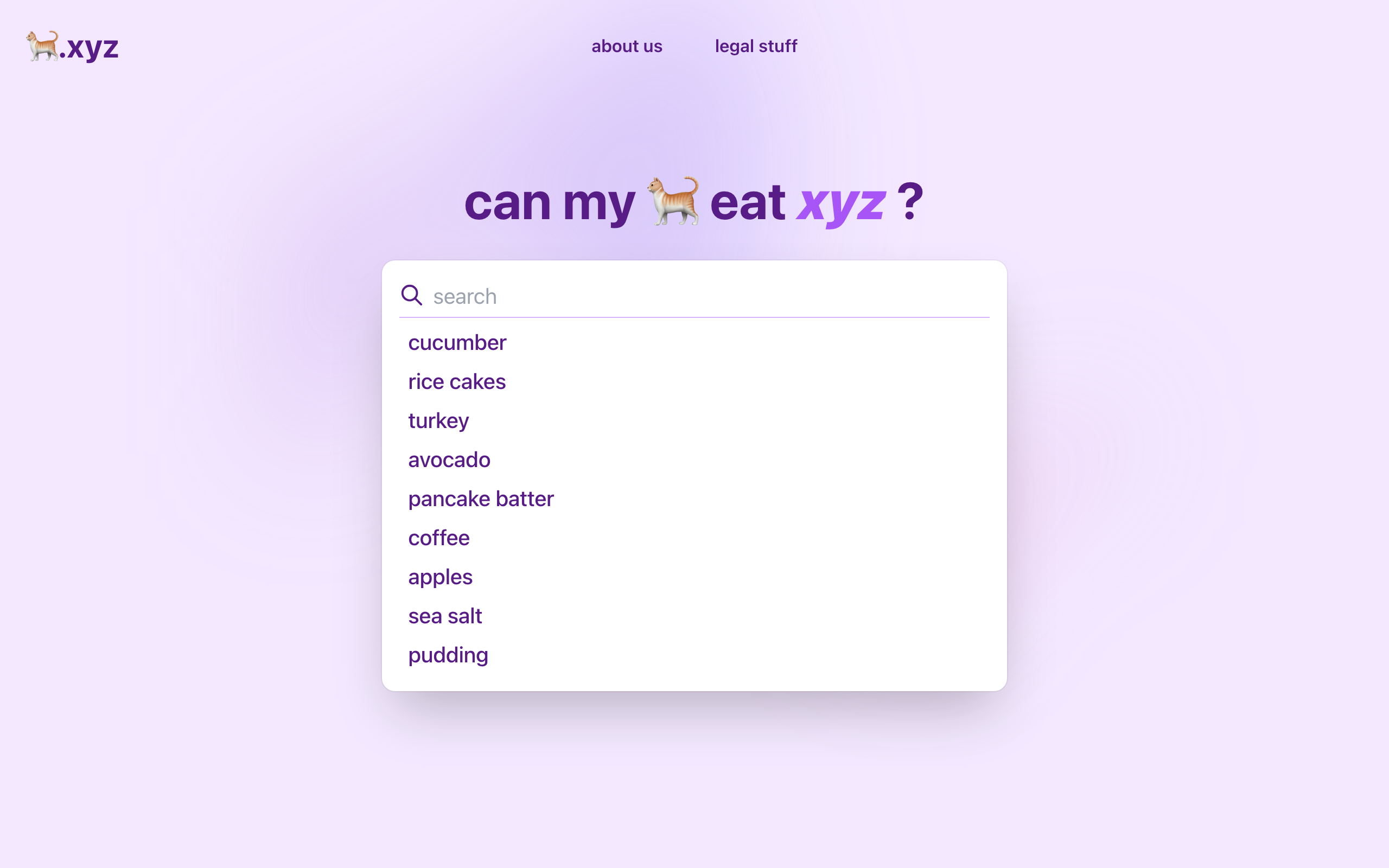
Fig. 3.2 canmycateat.xyz

Type any food and get a straight yes-or-no answer on whether your cat can eat it, with the reasoning. Known cat toxins get fixed, vetted answers; everything else comes from Gemini, cached in Firebase.

Stack
  • React
  • Tailwind CSS
  • Gemini API
  • Vercel Functions
  • Firebase
Year
2022
Line
F

3.2.1 What I built

  1. A single-purpose search UI in React and Tailwind CSS: one input, a list of suggested foods, and an answer page for each food.
  2. A Vercel serverless function wrapping Google’s Gemini API, so the API key stays server-side and never ships to the browser. A constrained prompt forces the yes/no-first format and returns a graceful “try a different food” when the question doesn’t make sense.
  3. Fixed answers for well-known cat toxins (lilies, onions and garlic, grapes, chocolate, caffeine, alcohol, xylitol, human painkillers, antifreeze), matched before the model is ever asked, so the most dangerous questions never depend on an AI getting it right.
  4. A Firebase Realtime Database cache of model answers, written only from the server and capped with a timeout so a cache outage falls back to the model instead of hanging the search.
  5. Guardrails for an AI answer about pets: an “AI-generated, not veterinary advice” note and the ASPCA Poison Control number under every answer, full terms and privacy pages, and analytics that load only after cookie consent.

3.2.2 Outcome

Live and free to use: ask it about grapes before your cat finds out the hard way.

3.3

idle

2026
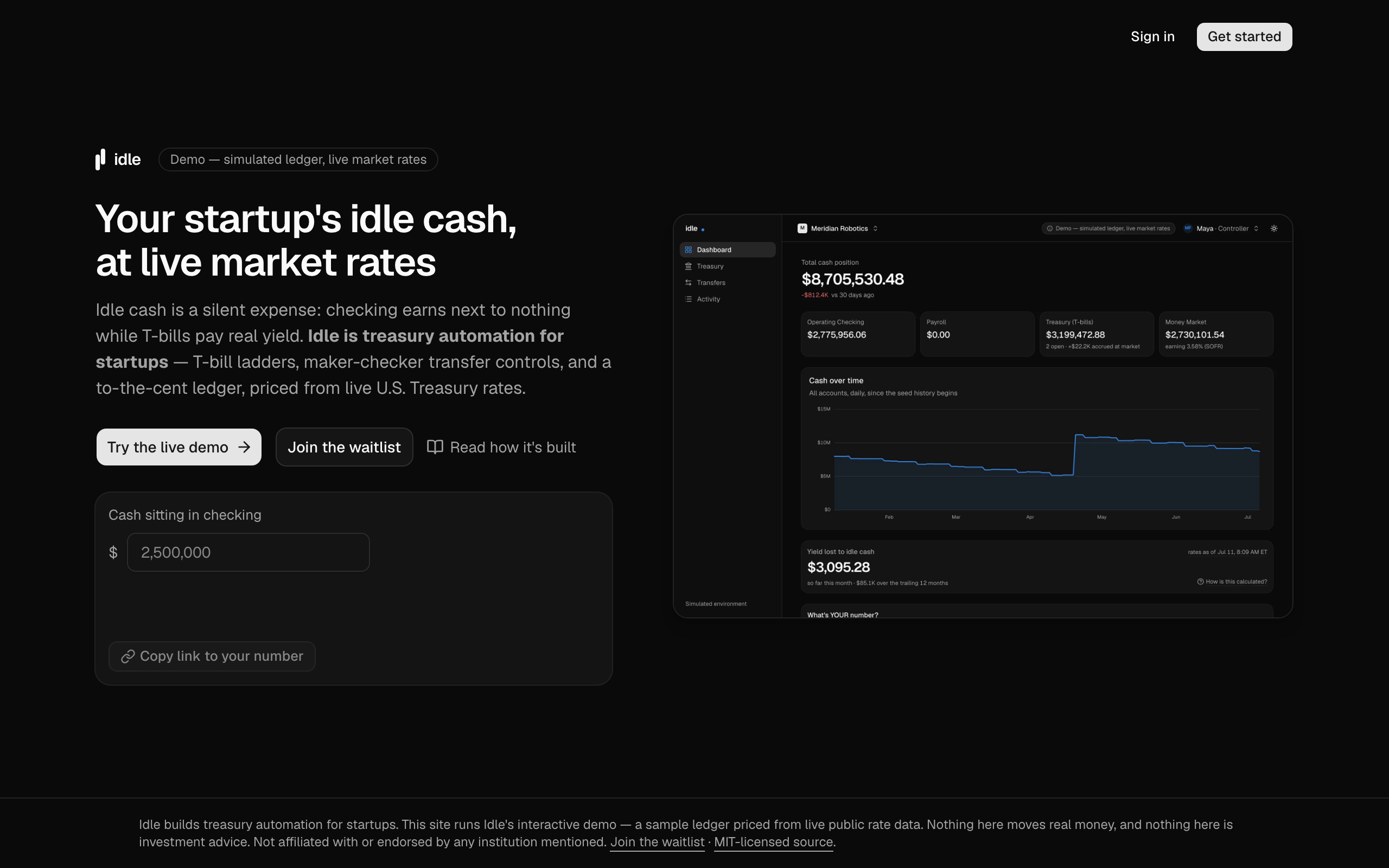
Fig. 3.3 idleidle-woad.vercel.app

A demo of treasury software for startups, built to practice money math: T-bill ladders, maker-checker transfer controls, and a to-the-cent ledger priced from live U.S. Treasury rates. Every rate is real and every cent is accounted for.

Stack
  • Next.js
  • TypeScript
  • Zustand
  • Vitest + fast-check
  • Playwright
Year
2026
Line
4

3.3.1 What I built

  1. A money library where every amount is integer cents in a bigint: floats never enter, and any operation that could produce a fraction takes an explicit rounding mode.
  2. An allocate primitive using the largest-remainder method, so a $500,000 ladder split across six maturities always reconciles to the input to the cent.
  3. Bond-equivalent yield computed exactly as 31 CFR 356 appendix B specifies, not an approximation, so bills and deposit products compare honestly.
  4. A transfer state machine with a 2 PM ET cutoff, banking-day awareness, and maker-checker dual approval, plus a demo clock to fast-forward settlement.

3.3.2 Outcome

Property-based tests (fast-check) hold the money invariants, and CI enforces 100% branch coverage on the money and analysis libraries. Add ?chaos=1 for a 20% simulated-network failure rate.

4.0 More Work

  1. 4.1

    Snake, but you’re driving the NYC subway: swipe a 16-bit pixel-art train around a route map, couple on cars as you pick up passengers, and share your crash as a Wordle-style emoji card.

    • TypeScript
    • HTML Canvas
    • Vite
  2. 4.2

    This site: a portfolio styled after the 1970 NYC Transit Authority Standards Manual, built with Astro so every page ships as static HTML with almost no JavaScript.

    • Astro
    • TypeScript
    • Content Collections
    • Umami
    • Vercel

5.0 Skills & Tech Stack

5.1

Core

  • TypeScript
  • JavaScript
  • HTML
  • CSS
5.2

Frameworks

  • React
  • Next.js
  • Astro
  • Tailwind CSS
5.3

Focus

  • Search and discovery UX
  • Frontend architecture
  • Web performance
  • Design systems
5.4

Quality

  • Jest
  • Playwright
  • Storybook
  • Accessibility
5.5

Platform

  • REST APIs
  • Vite
  • Vercel
  • Claude Code
5.6

Get in touch

Contact