

Idle
Treasury automation for startups: T-bill ladders, maker-checker transfer controls, and a to-the-cent ledger priced from live U.S. Treasury rates, with an interactive demo where every rate is real and every cent is accounted for.
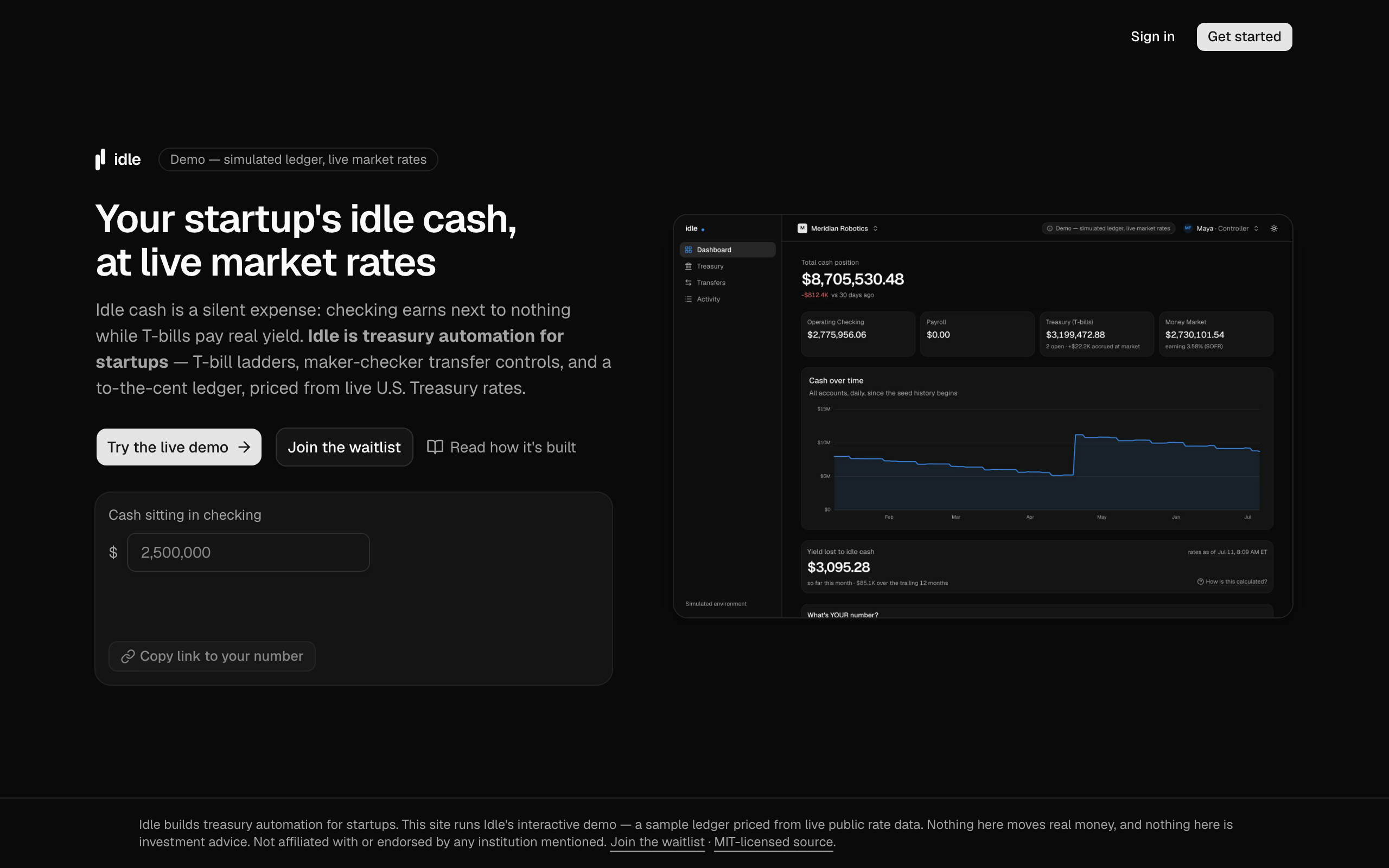
Overview
I’ve spent five years building financial UI at JPMorgan Chase, where the money is real and the tooling had decades of institutional weight behind it. Idle brings that discipline to the other end of the market: idle cash is a silent expense (checking earns next to nothing while T-bills pay real yield), so Idle gives startups T-bill ladders, maker-checker transfer controls, and a to-the-cent ledger. The site runs an interactive demo for a sample company, Meridian Robotics: SOFR, the effective fed funds rate, and T-bill auction results stream in live from FRED and Treasury FiscalData, while the ledger and bank connection are simulated in the browser.
What I built
- A money library where every amount is integer cents in a
bigint: floats never enter, and any operation that could produce a fraction takes an explicit rounding mode. - An
allocateprimitive using the largest-remainder method, so a $500,000 ladder split across six maturities always reconciles to the input to the cent. - Bond-equivalent yield computed exactly as 31 CFR 356 appendix B specifies, not an approximation, so bills and deposit products compare honestly.
- A transfer state machine with a 2 PM ET cutoff, banking-day awareness, and maker-checker dual approval, plus a demo clock to fast-forward settlement.
Outcome
Property-based tests (fast-check) hold the money invariants, and CI enforces 100%
branch coverage on the money and analysis libraries. Add ?chaos=1 for a 20%
simulated-network failure rate.